
Sandwich ELISA
Sandwich ELISA : Principle, Steps, Applications, Advantages and Limitations
Introduction to Sandwich ELISA
Sandwich ELISA (Enzyme-Linked Immunosorbent Assay) is a highly specific and sensitive immunoassay technique used to detect and quantify antigens in biological samples. It is called “sandwich” ELISA because the target antigen is captured between two layers of antibodies.
This method is widely used in diagnostics, research, and biotechnology, especially for detecting proteins such as cytokines, hormones, and biomarkers.
Principle of Sandwich ELISA
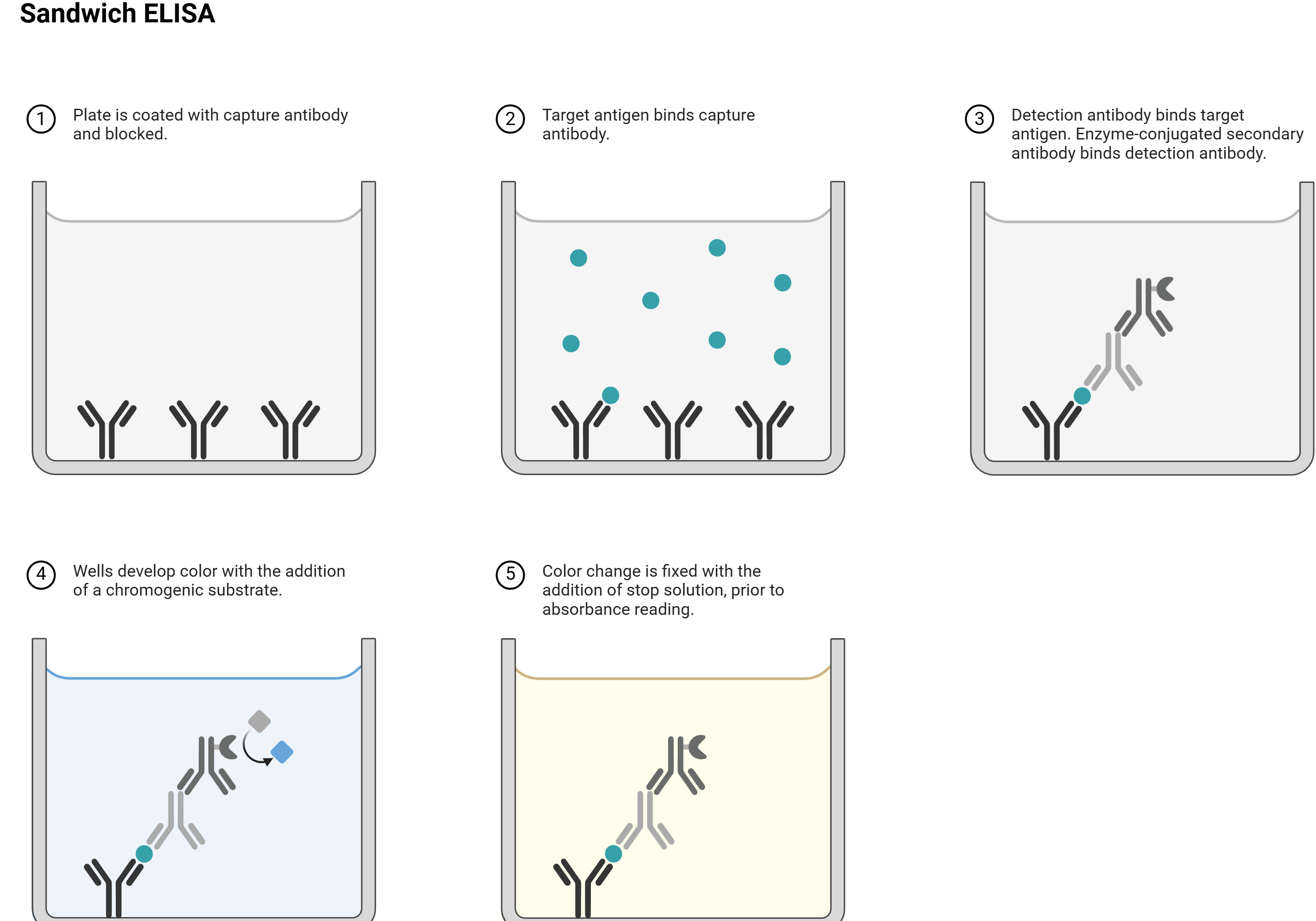
The principle of sandwich ELISA is based on the formation of an antibody-antigen-antibody complex :
- A capture antibody is immobilized on a microplate
- The target antigen binds to this antibody
- A detection antibody binds to another epitope on the antigen
- An enzyme-linked secondary antibody produces a measurable signal
Key Concept
The signal intensity is directly proportional to the amount of antigen present in the sample.
Components of Sandwich ELISA
Essential components include:
- Capture antibody (coated on plate)
- Target antigen (sample)
- Detection antibody (specific to antigen)
- Enzyme conjugate (e.g., HRP)
- Substrate (e.g., TMB)
- Stop solution
- Wash buffers
Steps of Sandwich ELISA
Step-by-Step Procedure
- Coating
- Microplate wells are coated with capture antibodies.
- Blocking
- Non-specific binding sites are blocked.
- Sample Addition
- Samples containing antigen are added and incubated.
- Detection Antibody
- Binds to the captured antigen.
- Enzyme-Conjugated Antibody
- Binds to detection antibody.
- Substrate Addition
- Enzyme reacts with substrate to produce color.
- Measurement
- Optical density is measured using a spectrophotometer.
How Sandwich ELISA Works (Visualization)
- Capture antibody binds antigen
- Detection antibody binds antigen
- Enzyme reaction produces measurable signal
This dual-recognition system ensures high specificity and sensitivity.
Applications of Sandwich ELISA
1. Clinical Diagnostics
- Detection of infectious diseases
- Measurement of biomarkers (e.g., CRP, PSA)
2. Cytokine Analysis
- IL-6, TNF-α, interferons
3. Hormone Quantification
- Insulin, growth hormone
4. Vaccine Development
- Antigen detection and immune response monitoring
5. Food Safety Testing
- Detection of allergens and contaminants
Advantages of Sandwich ELISA
- Very high specificity (two antibodies)
- High sensitivity
- Suitable for complex samples
- Minimal sample purification required
- Quantitative results
Limitations of Sandwich ELISA
- Requires matched antibody pairs
- More expensive than direct ELISA
- Potential cross-reactivity if antibodies are not highly specific
- Optimization can be time-consuming
Sandwich ELISA vs Other ELISA Types
| Feature | Sandwich ELISA | Direct ELISA | Indirect ELISA |
|---|---|---|---|
| Sensitivity | Very high | Low | Moderate |
| Specificity | Very high | Low | Moderate |
| Antibodies Used | Two | One | Two |
| Complexity | Higher | Simple | Moderate |
Tips to Optimize Sandwich ELISA
- Use high-affinity antibody pairs
- Optimize incubation times and temperatures
- Ensure proper washing to reduce background noise
- Use fresh substrate for better signal accuracy
Conclusion
Sandwich ELISA is one of the most reliable immunoassay techniques for detecting and quantifying proteins with high accuracy. Its dual-antibody approach provides superior sensitivity and specificity, making it indispensable in clinical diagnostics, biomedical research, and biotechnology.
Recent Posts
-
2× Hieff™ PCR Master Mix (No Dye)
Molecular Biology · PCR Reagents 2× Hieff™ PCR Master Mix (No Dye) Ready-to-use premixed solution …26th Oct 2026 -
D-Xylose Microplate Assay Kit
Metabolite Assay Kit D-Xylose Microplate Assay Kit Colorimetric detection and quantification of D- …26th Oct 2026 -
Aryl Hydrocarbon Receptor (AhR) Assay Kit
CELL-BASED REPORTER ASSAY Aryl Hydrocarbon Receptor (AhR) Assay Kit Investigate human AhR signali …26th Oct 2026