
Radioimmunoassay (RIA)
Radioimmunoassay (RIA) Principle, Procedure, Applications, Advantages and Limitations
Introduction to Radioimmunoassay (RIA)
Radioimmunoassay (RIA) is a highly sensitive laboratory technique used to measure minute concentrations of antigens (such as hormones, drugs, and proteins) in biological samples. It combines the specificity of antigen-antibody interactions with the sensitivity of radioactive detection.
Developed in the 1960s by Rosalyn Yalow and Solomon Berson, RIA revolutionized clinical diagnostics and earned Yalow the Nobel Prize in Physiology or Medicine in 1977.
Principle of Radioimmunoassay
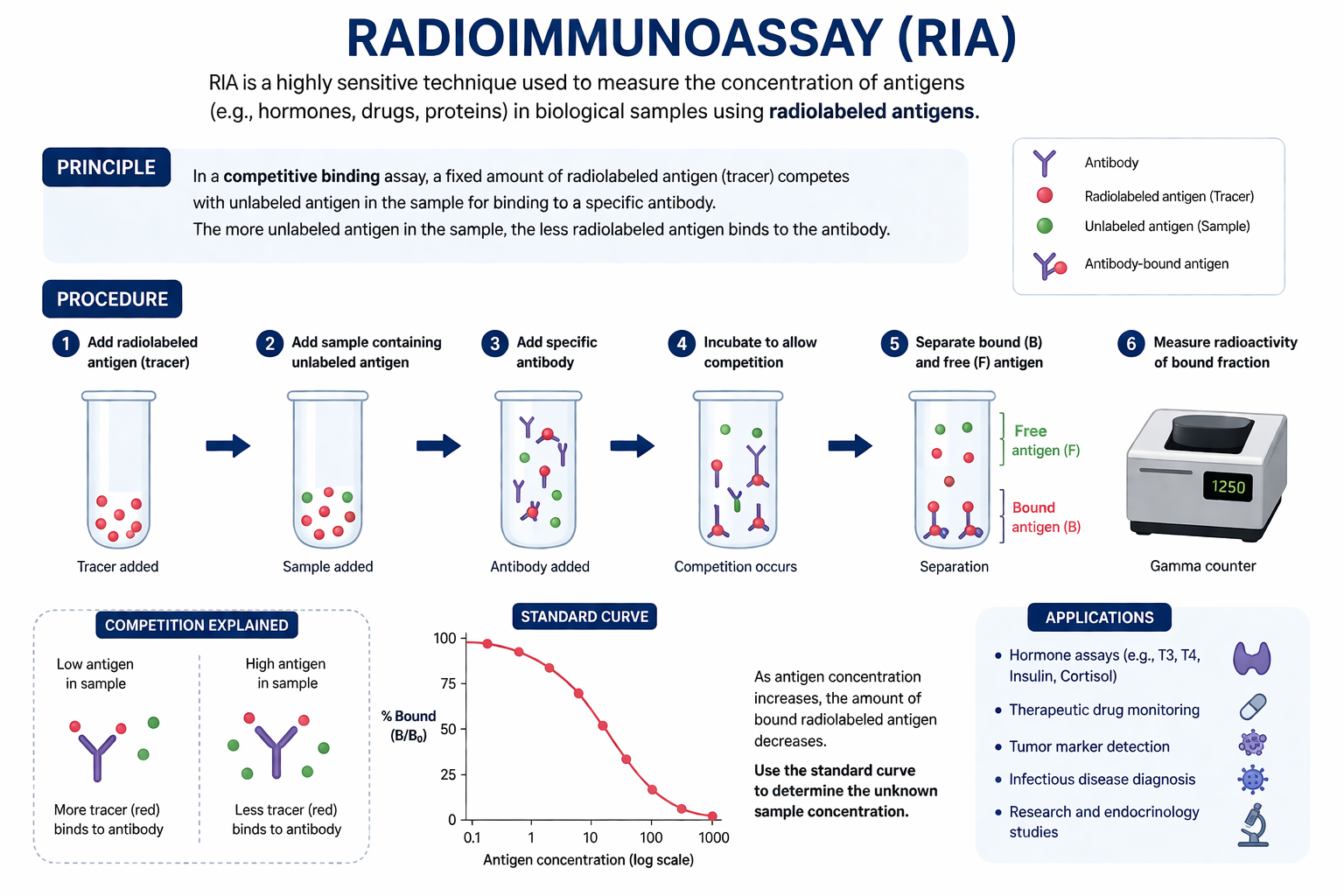
The principle of Radioimmunoassay is based on competitive binding between:
- A radioactively labeled antigen (known)
- An unlabeled antigen (sample/unknown)
- A specific antibody
How It Works
- A fixed amount of antibody is mixed with:
- Radiolabeled antigen
- Sample containing unknown antigen
- Both labeled and unlabeled antigens compete for antibody binding sites.
- The more antigen present in the sample:
- The less radioactive antigen binds to the antibody
- The bound and free antigens are separated, and radioactivity is measured.
- The concentration of the unknown antigen is calculated using a standard calibration curve.
Components of RIA
Key components required for Radioimmunoassay include:
- Antigen (analyte of interest)
- Radiolabeled antigen (commonly labeled with isotopes like Iodine-125)
- Specific antibody
- Standards (known antigen concentrations)
- Separation system (to isolate bound/free fractions)
- Gamma counter (to measure radioactivity)
Procedure of Radioimmunoassay
Step-by-Step Process
- Preparation of Standards and Samples
- Prepare a series of known antigen concentrations.
- Addition of Radiolabeled Antigen
- Add a constant amount to all tubes.
- Addition of Antibody
- Allow binding between antigen and antibody.
- Incubation
- Ensures equilibrium between bound and free antigen.
- Separation
- Separate antibody-bound antigen from free antigen.
- Measurement
- Use a gamma counter to measure radioactivity.
- Data Analysis
- Plot a standard curve and determine unknown concentrations.
Applications of Radioimmunoassay
RIA is widely used in clinical diagnostics, research, and pharmacology:
1. Hormone Measurement
- Thyroid hormones (T3, T4)
- Insulin
- Cortisol
2. Drug Detection
- Monitoring therapeutic drug levels
- Detecting narcotics and toxins
3. Infectious Disease Diagnosis
- Detection of viral antigens
4. Cancer Research
- Tumor markers detection
5. Endocrinology Studies
- Measuring very low hormone concentrations
Advantages of Radioimmunoassay
- Extremely high sensitivity (detects picogram levels)
- High specificity due to antigen-antibody interaction
- Quantitative and accurate
- Suitable for small sample volumes
Limitations of Radioimmunoassay
- Use of radioactive materials (health and safety concerns)
- Requires specialized equipment (gamma counter)
- Short shelf-life of radioactive reagents
- Disposal of radioactive waste is regulated
- Gradually replaced by safer techniques like ELISA
RIA vs ELISA
| Feature | RIA | ELISA |
|---|---|---|
| Detection | Radioactive | Enzymatic (color change) |
| Sensitivity | Very high | High |
| Safety | Hazardous | Safe |
| Equipment | Gamma counter | Spectrophotometer |
| Cost | Expensive | Cost-effective |
Conclusion
Radioimmunoassay (RIA) remains one of the most sensitive analytical techniques for detecting trace amounts of biological substances. Despite its limitations due to radioactive hazards, it laid the foundation for modern immunoassays like ELISA and continues to be valuable in specialized applications.
Recent Posts
-
FITC Anti-Mouse CD16/32 Antibody
FLOW CYTOMETRY · IMMUNOLOGY · CELL BIOLOGY FITC Anti-Mouse CD16/32 Antibody A fluorescein isothioc …19th Oct 2026 -
γ-[(8-Aminooctyl)-imido]-ATP
NUCLEOTIDE ANALOG · BIOCHEMISTRY · MOLECULAR BIOLOGY γ-[(8-Aminooctyl)-imido]-ATP γ-[(8-Aminooctyl …19th Oct 2026 -
CD19 Antibody
PRIMARY ANTIBODY · IMMUNOLOGY · CELL BIOLOGY CD19 Antibody Rabbit antibody targeting CD19 (B-lymph …19th Oct 2026