
Oligo dT Primers
MOLECULAR BIOLOGY • RNA RESEARCH
Oligo-dT Primers: What They Are, How They Work and When to Use Them
Discover how oligo-dT primers recognize the poly(A) tail of messenger RNA (mRNA) and support reverse transcription, cDNA synthesis, and gene expression studies.
Introduction
Oligo-dT primers are essential molecular biology tools commonly used in reverse transcription and complementary DNA (cDNA) synthesis. They allow researchers to selectively initiate DNA synthesis from messenger RNA (mRNA) molecules containing a polyadenylated tail, also known as the poly(A) tail.
Because most mature eukaryotic mRNAs contain a poly(A) tail at their 3′ end, oligo-dT primers are widely used in gene expression analysis, reverse transcription PCR (RT-PCR), and other RNA-based research applications.
Understanding how these primers work can help researchers select appropriate reverse transcription strategies and obtain reliable experimental results.
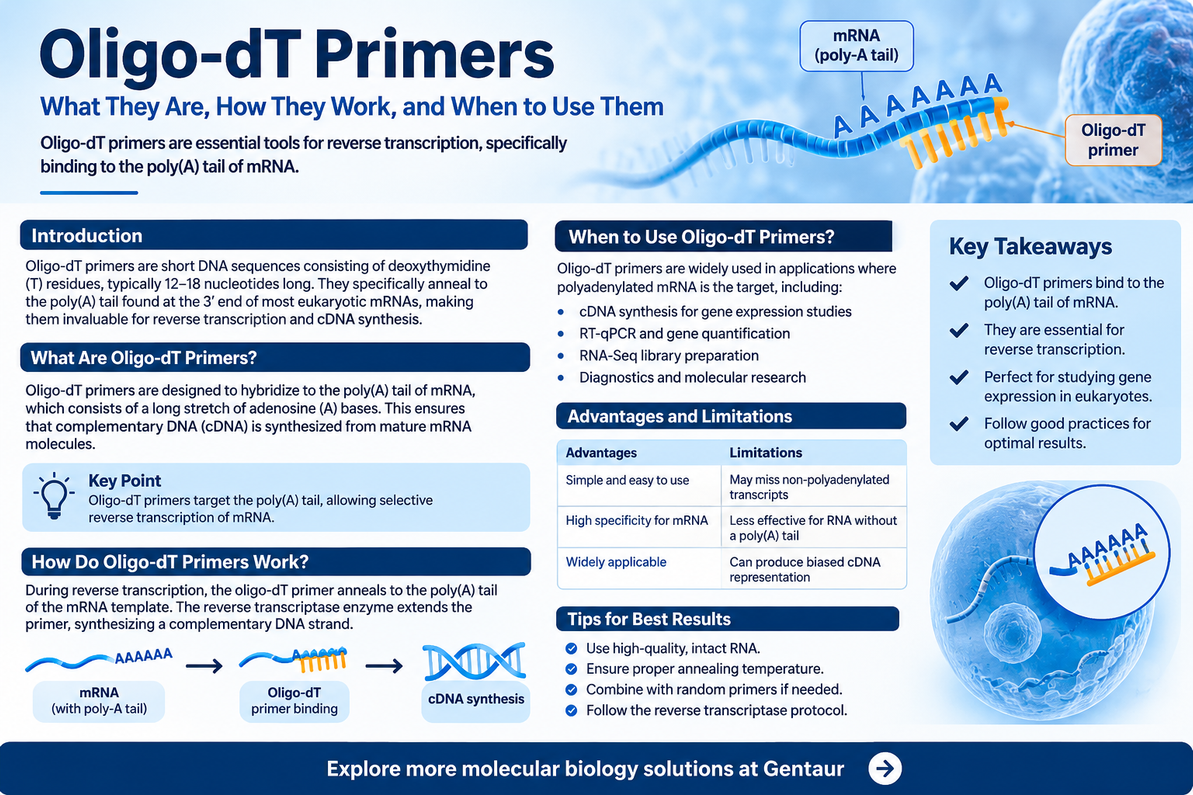
Oligo-dT primers are short DNA sequences made of thymidine (T) nucleotides that bind to the poly(A) tail of mRNA, allowing reverse transcriptase to synthesize complementary DNA.
1. What Are Oligo-dT Primers?
Oligo-dT primers are short synthetic DNA oligonucleotides composed primarily of deoxythymidine residues. They are designed to hybridize with the poly(A) tail found at the 3′ end of most mature eukaryotic messenger RNA molecules.
The poly(A) tail consists of a sequence of adenine (A) nucleotides. Through complementary base pairing, thymidine residues in the primer bind to adenine residues in the mRNA tail.
How does complementary binding work?
mRNA poly(A) tail:
5′ - A A A A A A A A - 3′
Oligo-dT primer:
3′ - T T T T T T T T - 5′
The two sequences bind through complementary A–T base pairing.
2. How Do Oligo-dT Primers Work?
Oligo-dT primers function during reverse transcription, a process in which RNA is used as a template to synthesize complementary DNA (cDNA).
The process involves several molecular steps:
Step 1: RNA Preparation
RNA is isolated from biological samples, such as cultured cells, tissues, or other biological materials. RNA integrity and purity are important for successful reverse transcription.
Step 2: Primer Annealing
The oligo-dT primer binds to the complementary poly(A) tail at the 3′ end of the mRNA molecule through hydrogen bonding.
Step 3: Reverse Transcription
Reverse transcriptase recognizes the primer-template complex and extends the primer by adding complementary DNA nucleotides, using the mRNA as a template.
Step 4: cDNA Formation
A complementary DNA strand is produced. The resulting cDNA can be used in downstream applications such as PCR, quantitative PCR, cloning, and gene expression analysis.
3. Applications of Oligo-dT Primers in Molecular Biology
Oligo-dT primers are widely used in molecular biology laboratories, particularly in experiments involving eukaryotic mRNA and gene expression.
cDNA Synthesis
Used to initiate reverse transcription and produce complementary DNA from polyadenylated mRNA.
Gene Expression Analysis
Supports the conversion of mRNA into cDNA for studying gene expression patterns.
RT-PCR and RT-qPCR
Provides a starting point for cDNA preparation before PCR-based gene expression analysis.
RNA Sequencing
Used in certain poly(A)-selected RNA sequencing workflows for preparing cDNA libraries.
Molecular Research
Helps researchers investigate transcriptional activity and RNA-related biological processes.
cDNA Libraries
Can be used to generate cDNA populations representing polyadenylated transcripts.
4. Advantages and Limitations of Oligo-dT Primers
Oligo-dT primers offer selective priming of polyadenylated RNA, but their use also introduces certain experimental limitations.
| Advantages | Limitations |
|---|---|
| Selective priming of poly(A)-containing mRNA. | Less effective for non-polyadenylated RNA. |
| Useful for gene expression studies. | May introduce 3′-end bias in cDNA representation. |
| Compatible with many reverse transcription workflows. | RNA degradation can reduce full-length cDNA synthesis. |
| Simple and widely applicable. | Not suitable as the only priming strategy for every RNA target. |
5. Oligo-dT Primers vs Random Primers
Oligo-dT primers and random primers are two common strategies for initiating reverse transcription. The choice depends on the RNA type and the experimental objective.
| Feature | Oligo-dT Primers | Random Primers |
|---|---|---|
| Binding target | Poly(A) tail | Multiple RNA regions |
| RNA preference | Polyadenylated RNA | Different RNA types |
| Specificity | Targets poly(A) regions | Broad priming across RNA |
| Common application | mRNA analysis | RNA with or without poly(A) tails |
A combination of oligo-dT and random primers may be useful when broader transcript coverage is required.
6. Best Practices for Using Oligo-dT Primers
Proper experimental preparation and reaction optimization help improve the reliability of reverse transcription and cDNA synthesis.
Use high-quality RNA
RNA integrity and purity are important for obtaining reliable reverse transcription results. Avoid RNase contamination during sample preparation and handling.
Optimize primer annealing
Follow the recommended annealing conditions for the oligo-dT primer and reverse transcriptase system being used.
Select the appropriate priming strategy
Consider oligo-dT, random primers, or a combination of both depending on RNA characteristics and the desired transcript coverage.
Follow the experimental protocol
Use appropriate reaction temperatures, incubation times, and reagent concentrations according to the reverse transcription protocol.
7. Frequently Asked Questions About Oligo-dT Primers
What is the main function of oligo-dT primers?
Their main function is to bind to the poly(A) tail of mRNA and initiate complementary DNA synthesis during reverse transcription.
Why are oligo-dT primers used in cDNA synthesis?
They selectively initiate reverse transcription from polyadenylated RNA, making them useful for preparing cDNA from mature eukaryotic mRNA.
Do oligo-dT primers bind to all RNA molecules?
No. They primarily bind to RNA molecules containing a sufficiently accessible poly(A) tail. Many non-polyadenylated RNAs are not efficiently primed by oligo-dT primers.
What is the difference between oligo-dT and random primers?
Oligo-dT primers target poly(A) tails, while random primers bind at multiple complementary locations throughout RNA molecules.
Can oligo-dT primers be used for RT-qPCR?
Yes. They can be used during the reverse transcription step to produce cDNA, which is subsequently analyzed by quantitative PCR.
What is the poly(A) tail?
The poly(A) tail is a stretch of adenine nucleotides located at the 3′ end of most mature eukaryotic mRNA molecules. It contributes to mRNA stability, export, and translation.
Conclusion
Oligo-dT primers are important tools in molecular biology because they enable selective initiation of reverse transcription from polyadenylated mRNA. By binding to the poly(A) tail, these primers support cDNA synthesis and downstream applications such as RT-PCR, RT-qPCR, gene expression analysis, and RNA research.
Understanding their mechanism, advantages, and limitations helps researchers select the most appropriate priming strategy for their experiments.
For laboratories working with RNA and gene expression, oligo-dT primers remain a valuable component of many molecular biology workflows.
Scientific References and Further Reading
- Bustin SA, et al. (2009). The MIQE Guidelines: Minimum Information for Publication of Quantitative Real-Time PCR Experiments. Clinical Chemistry, 55(4), 611–622. Read scientific paper.
- Nilsen TW. (2013). Transcription and RNA processing. In: Molecular Biology of the Cell. Garland Science. NCBI Bookshelf.
- Vandesompele J, et al. (2002). Accurate normalization of real-time quantitative RT-PCR data by geometric averaging of multiple internal control genes. Genome Biology, 3, research0034. Read scientific paper.
- Chomczynski P, Sacchi N. (1987). Single-step method of RNA isolation by acid guanidinium thiocyanate-phenol-chloroform extraction. Analytical Biochemistry, 162(1), 156–159. Read scientific paper.
Explore Molecular Biology Solutions at Gentaur
Discover laboratory products and research resources for RNA studies, reverse transcription, and molecular biology applications.
EXPLORE GENTAUR PRODUCTSRecent Posts
-
Oligo dT Primers
MOLECULAR BIOLOGY • RNA RESEARCH Oligo-dT Primers: What They Are, How They Work and When to Use Th …9th Nov 2026 -
What Is Annealing in PCR?
MOLECULAR BIOLOGY • PCR TECHNIQUES What Is Annealing in PCR? Understand the annealing step in Poly …9th Nov 2026 -
Hieff Trans™ Booster DNA/RNA Transfection Reagent
MOLECULAR BIOLOGY & GENE DELIVERY Hieff Trans™ Booster DNA/RNA Transfection Reagent Advanced nucle …5th Nov 2026